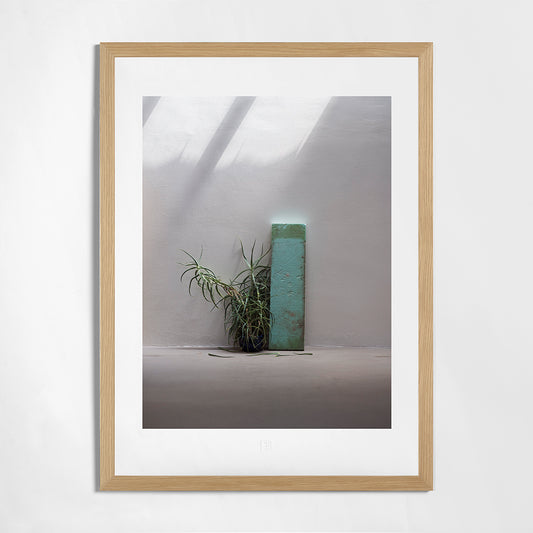
At the time the Volman Villa was commissioned by a Čelákovice industrialist in the 1930s, surrealism dominated the visual arts, art deco reigned in design, and currents of geometricism and photopurism prevailed in photography. In Bohemia, the direction was set by Jaromír Funke, Jaroslav Rössler, and František Drtikol—artists whose work continues to inspire creators around the world today. Abroad, key drivers of vibrant photography included the likes of Henri Cartier-Bresson and André Kertész, founder of the photo-essay principle. During the same period, the first professional photography school was established in Paris, and the first color photographic material was invented.
This is a period Ivan Pinkava (born 1961) often draws upon, and one that leaves a strong imprint on his work. As he himself mentions: "The 1920s and 30s are my weakness. Modernism has gotten under my skin. In a way, its aesthetics still accompany me, and they regularly creep back into my work from somewhere through unexpected cracks, even though the goals are logically long since different." His photographic cycles often capture the existential state of an individual within society, placed in a kind of temporal vacuum where we sometimes infer the era of their creation only through subtle clues. The artist's earlier figurative compositions are increasingly being replaced by abstract photographs—almost minimalist landscapes that induce a metaphysical state of mind, confronting us with questions about what remains eternal, the meaning of our individual existence, and where a form of hope might lie.
Pinkava, who is able to combine a strong sensibility for painting and sculpture with a sense for scene and existential drama, showcases used, destroyed objects in a somewhat subversive way. He shifts the boundaries of their perception, grants them new meaning and status, and opens up a field for interpreting their fragility, pointing to both hope and disillusionment, beauty and transience.
In his black-and-white—and recently, color—photographs, he repeatedly and subtly references the work of his predecessors, such as František Drtikol, Josef Sudek, and Jan Svoboda, by utilizing objects connected to their personal artistic histories. He is equally fond of finding parallels to important icons from European art history, such as Caravaggio, Caspar D. Friedrich, J. A. D. Ingres, Giorgio Morandi, and others.
Our shared vision was to connect the context of that time with the present, to highlight societal changes and the fates of the villa itself and its family throughout all its joyful and dark chapters, and to point out possible similarities and starting points that threaten us even today.
Curator: Blanka Čermáková