Kurt Gebauer Kurt GebauerSochař, malíř a pedagog, jedna z nejvýznamnějších osobností českého sochařství druhé poloviny 20

Running Girl (SOLD OUT)

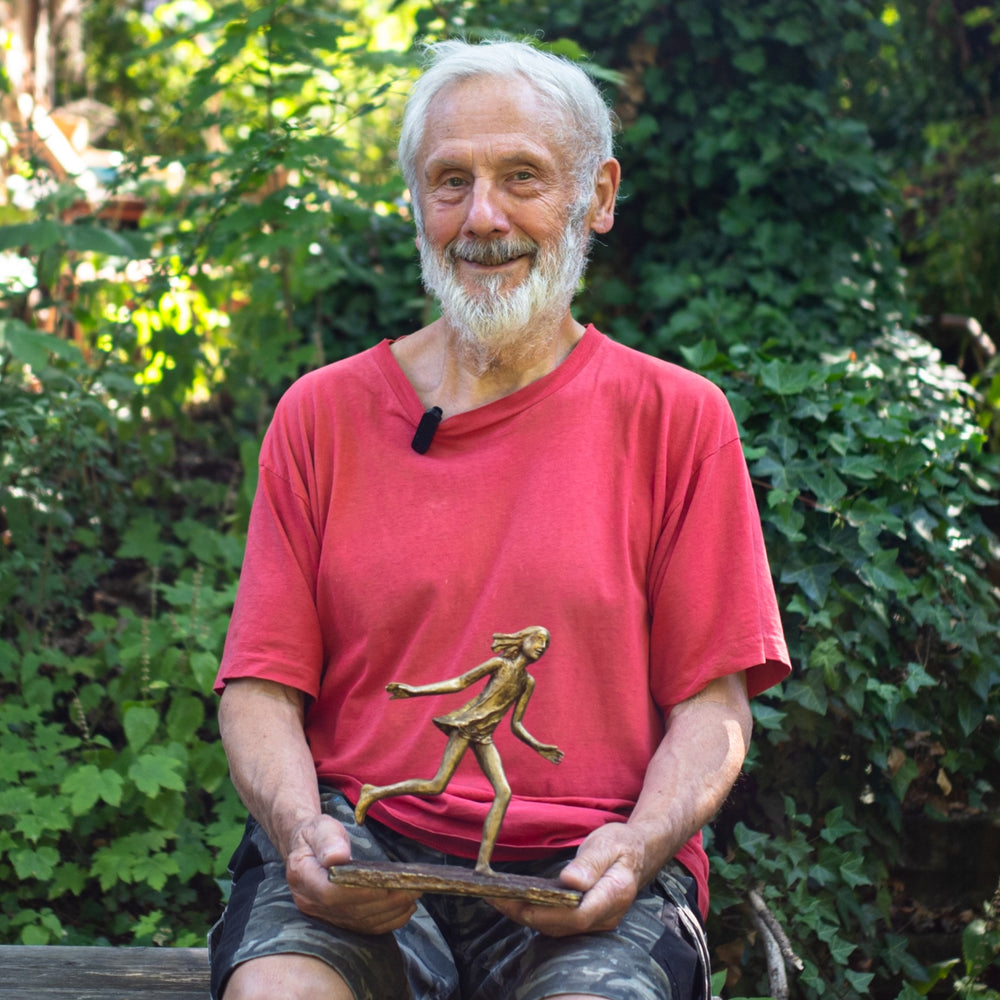
Kurt Gebauer has been shaping Czech sculpture for over sixty years: as a creator of public space icons, as a professor who trained the current generation of sculptors after the revolution, and as an artist represented in collections both at home and abroad. He comes to 100ks for the first time, and with an exceptional format: our very first object edition, a cast of his iconic Running Girl.

Technique
cast resin with hand-applied patina and bronze powder. The surface of each piece is unique.
Object dimensions
height 20 cm + 1.5 cm base | base: 19.8 cm × 16 cm
Weight
approx. 500 g
Edition
80 pcs, each object with a hand-engraved number
Certificate
certificate with a hand-written number and signature by Kurt Gebauer
Packaging
wooden presentation box
€836,95
incl. VAT · shipping at checkout
Sold out

The edition is sold out and no further pieces will be made.
Shipping across Europe14-day returns10,000+ customers
Limited edition · 100 piecesNumbered
The artist fills in the number and signs the certificate of every piece by hand.Edition number engraved directly on the objectFixed edition size, no further pieces will be made
How numbering and pre-sales work
Kurt Gebauer

Profile

Kurt Gebauer

Kurt Gebauer (*1941) je sochař, malíř a pedagog, jedna z nejvýznamnějších osobností českého sochařství druhé poloviny 20. století. Jeho díla zabydlela český veřejný prostor jako málokterá jiná: Srdce pro Václava Havla u Národního divadla v Praze, obří Trpaslíci z osmdesátých let, Děvče na židli v Ostravě-Hrabůvce, bronzový Mozart před brněnskou Redutou i zrcátkové ceny TýTý. Po sametové revoluci převzal sochařský ateliér na pražské UMPRUM, přejmenoval ho na Ateliér veškerého sochařství a přes dvacet let v něm formoval současnou českou sochařskou scénu. V roce 2020 mu Národní galerie Praha uspořádala ve Veletržním paláci rozsáhlou retrospektivu a Česká akademie vizuálního umění ho vyhlásila Umělcem roku; za rok 2025 ho uvedla do své Síně slávy. Jeho práce jsou zastoupeny ve sbírkách Národní galerie Praha, Muzea umění Olomouc nebo antverpského muzea Middelheim, kde jeho socha stojí mezi pracemi Rodina, Moora a Caldera.

About the work

Kurt Gebauer for 100 pcs

That is a very long story. I was a young, quite provocative sculptor in Prague at the time, because we were rebelling against the censorship of the Union of Fine Artists. Even so, I was commissioned to create a statue for a new shopping mall in Opava.

I originally proposed the Opava river with its tributaries, a sort of pool with arms and legs, with the statue of the river rising above it. There was no money for that. So I offered them a running girl, a smaller piece for which I had already finished a model long ago. The drawing dates back to the sixties, and the idea itself came about sometime around 1974.

The Running Girl was approved and had even been cast in bronze when a young communist rose to power in Opava—a cultural inspector. And suddenly, the statue couldn't be placed anywhere in Opava because, they claimed, people might interpret it as running from the East to the West. You see, she has an expression that is universal. It's not just about her running joyfully, but perhaps running from something. And they asked me if I would take a file, perhaps, and make the corners of her mouth smile more. I told them no way.

In the end, she didn't fit in front of the shopping mall anyway, because the person who drew the paths used a different French curve and made a mistake. So, they started looking for another spot.

Later, Kotalík and the National Gallery selected her for an exhibition of socialist states in Antwerp, at Middelheim. That was the first and, at the time, largest open-air sculpture museum, where they have works by Henry Moore, Calder, Maillol, and Rodin. And Middelheim wanted to buy it. The chief architect of Opava, an excellent and courageous man, took advantage of this. He declared that Opava must have such an important piece; they didn't allow the sale, and the statue was given a place in front of the House of Art, where it stands to this day.

We still had to shape the terrain for her, because she isn't meant to stand on a pedestal. The committee suggested a pedestal, but then she would be jumping over a box. I said she wasn't jumping over any box.

Middelheim eventually bought another cast, which stands there to this day, and the National Gallery has one too. People in Opava say: "Oh, the Running Girl, that's my youth, I used to walk past her." She became an icon. It's amazing that such a statue can even come to be. It wasn't easy, though.

Running Girl (SOLD OUT) · click to enlarge

The object up close

Studio photos of the object.

Shipping, delivery and returns

Shipping is calculated at checkout by country.

Details on shipping, delivery and returns are on the Everything about buying and Shipping pages.

How edition numbering and pre-sales work

Every edition has a fixed size. Every object carries an engraved edition number and comes with a certificate in which the artist fills in the number and signs by hand. During a pre-sale you choose your number; after the pre-sale ends, numbers are assigned in order of purchase. Details are on the Edition sizes page.